Every set of annual accounts sits on top of a pile of working. Someone has to prove that the cash figure is really the cash figure, that the fixed assets tie to the register, and that the tax number was worked out properly. That proof is the workpaper file.
Most accountants build workpapers every year without ever stopping to define what a good one looks like. The standard lives in the way each firm does things, passed on by whoever trained you. That works until you inherit a file from someone who has left, or a reviewer opens your tab and has to message you to ask what a number means.
So it is worth setting out plainly: what a workpaper actually is, what belongs in the file, and what separates a workpaper that is ready for review from one that only makes sense to the person who wrote it.
What a workpaper actually is
A workpaper is the evidence for one balance or one section of the accounts. It shows what the balance is, where it came from, how it was checked, and what you concluded.
What the balance is. The figure being proved, as it appears in the accounts.
Where it came from. The source, whether that is a bank statement, an asset register, or a payroll report.
How it was checked. The work you actually did to prove it.
What you concluded. Including any judgement calls you made along the way.
Take a bank reconciliation. The workpaper shows the balance per the ledger, the balance per the statement, the items that explain the gap, and a tick to say the two agree. Anyone reading it can follow the logic without needing you in the room. That is the whole point of a workpaper. It carries the thinking so the number does not have to be taken on trust.
A single workpaper proves a single thing. The file is all of them together, organised so a reviewer can move through the accounts in order.
What belongs in the file
A workpaper file is more than a folder of schedules. A clean one has a shape to it.
An index. This is the most useful page in the file and the most commonly wasted one. At a minimum it lists every workpaper and lets a reviewer jump to the section they want. A good one does more than that. It tells you the state of the file without opening a single tab.
Three things are worth showing against each workpaper on the index:
Whether it is still connected to the ledger. A workpaper that has come unlinked from the GL is the quiet failure in most files. The number looks fine. It just stopped updating three weeks ago.
Where the work is up to. In progress, completed, queries outstanding. A manager should be able to see what is actually left to do without asking the preparer.
Whether it has been signed. Who has signed each workpaper, and at what level.
Put those on one page and the index stops being a contents list and starts being the control panel for the job. It is where a reviewer should start, and it is what tells a partner whether a file is genuinely ready to come up the chain.
The workpapers themselves. The working for each balance, referenced on the index so a number can be traced end to end. Where a balance is made up of several accounts, for example three bank accounts or a group of fixed asset codes, the workpaper shows each account and totals them, with that total agreeing to the trial balance. The aggregation belongs on the workpaper, next to the working, not on a separate summary sheet nobody maintains.
Sign-off. A record of who prepared the file, who reviewed it, and when. This is the part that turns a spreadsheet into a compliance record, and it is the part that most often gets left until the end and then done from memory.
The common workpapers
Most annual accounts files cover the same ground. The wording changes a little between New Zealand and Australia, but the work is the same.
Bank reconciliation. Ledger balance agreed to the statement.
Debtors and creditors. Accounts receivable and payable agreed to the aged listings.
GST reconciliation. Returns agreed to the ledger. In Australia this usually sits alongside the BAS reconciliation.
Wages. Agreed to the payroll reports, with PAYE in New Zealand or PAYG in Australia, plus superannuation and payroll tax reasonableness checks.
Fixed assets. Additions, disposals, and depreciation agreed to the asset register.
Provisions, accruals, and prepayments. The year-end adjustments, with the basis for each shown.
Loans and hire purchase. Agreed to statements, with interest and principal split out.
Income tax. The tax reconciliation and the provision for tax.
Equity and dividends. Movements for the year, plus the franking account in Australia.
Not every file needs every one, and a small entity may need only a handful. The list is a starting point, not a rule.
What makes a workpaper review-ready
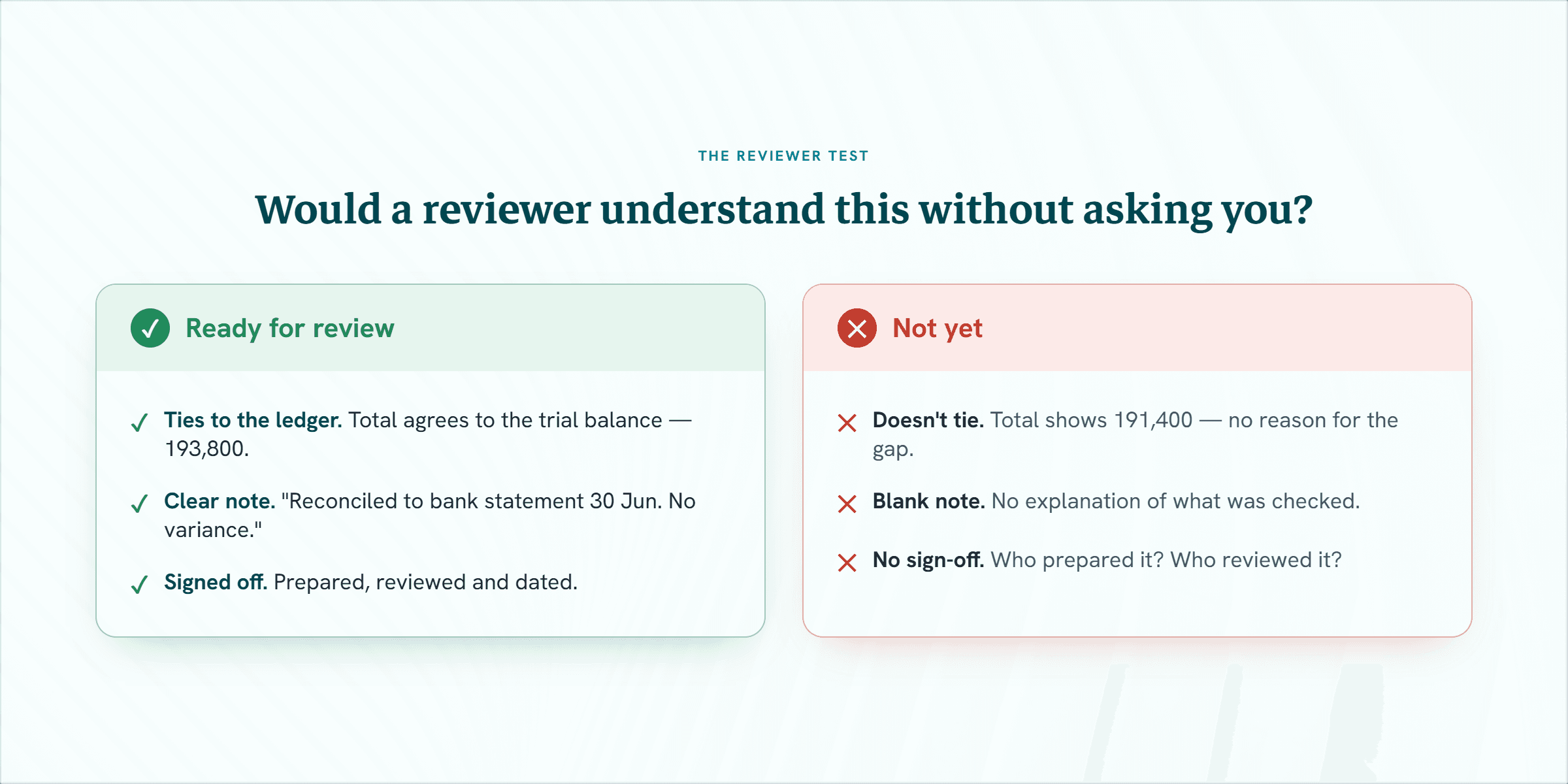
Here is the test worth holding your whole team to. Would a reviewer understand this workpaper without asking you a single question?
That idea is borrowed from the auditing world, where a file is meant to be clear to an experienced practitioner who has never seen the job before. It is a high bar, and it is the right one for compliance work too. If the reviewer has to come back to you to find out what a figure means or where it came from, the workpaper has not finished its job.
A review-ready workpaper tends to do a few things well.
It explains itself. The source, the check, and the conclusion are all on the face of the workpaper. Nothing important lives only in your head.
It ties back to the ledger. The balance on the workpaper agrees to the trial balance, and the working underneath agrees to the balance. A reviewer should be able to trace any number down to its detail and back up again, and should be able to see that the link to the ledger is still live rather than something that worked in March.
It looks like every other file in the firm. A standard index and a standard layout mean a reviewer knows where to look, whoever prepared the file. Consistency is what lets a firm scale its review.
It shows judgement, not just numbers. If you decided a variance was immaterial and left it, say so. That saves the next person hours of chasing something you already thought about.
It is signed off in tiers. Preparer, then manager, then partner, with the file clean before it moves up the chain.
Get those right and the review stops being a hunt for basic errors and becomes what it is meant to be, a check on judgement.
Where the file lives
None of this depends on the tool. A review-ready workpaper is review-ready whether it sits in a cloud platform or a spreadsheet, and most firms in New Zealand and Australia still build theirs in Excel for good reasons. The tooling question, how you get Xero data into the file and keep it current, is a separate one, and we have written about it a few times already:
Why accountants still build workpapers in Excel
The hidden cost of copying Xero data into Excel by hand
What two-way sync actually means, and why import is not enough
The standards above sit underneath all of that. Sort out what a good workpaper looks like first, then worry about the fastest way to build one.
A quick checklist
Before a file goes to review, run it past this:
Does the index list everything, and does every workpaper have a reference?
Does every workpaper agree to the trial balance, and is the link to the ledger still live?
Can each balance be traced to its supporting proof?
Would a reviewer understand every workpaper without asking you?
Are judgement calls and immaterial items noted, not left blank?
Is the file signed off by the preparer before it moves up?
A good workpaper is one the next person can follow
A workpaper proves a number. It shows what the balance is, where it came from, how it was checked, and what you concluded. The file is all of those workpapers organised so a reviewer can move through the accounts in order, with an index that shows the state of every one of them, working that ties back to the trial balance, and a clear record of who prepared and reviewed it.
What separates a good file from a messy one is not how it looks. It is whether the next person can follow it on their own. Hold your team to the reviewer test, keep the layout consistent across the firm, show your judgement rather than just your numbers, and sign off in tiers. Do that and the review stops being a hunt for basic errors and becomes a real check on quality.
The standards matter more than the tool. A review-ready workpaper is review-ready whether it lives in a cloud platform or a spreadsheet. Sort out what good looks like first, then find the fastest way to build it. That next person reading your file is often you, a year later, with no memory of the job, so the standard is worth holding even when you are busy.